
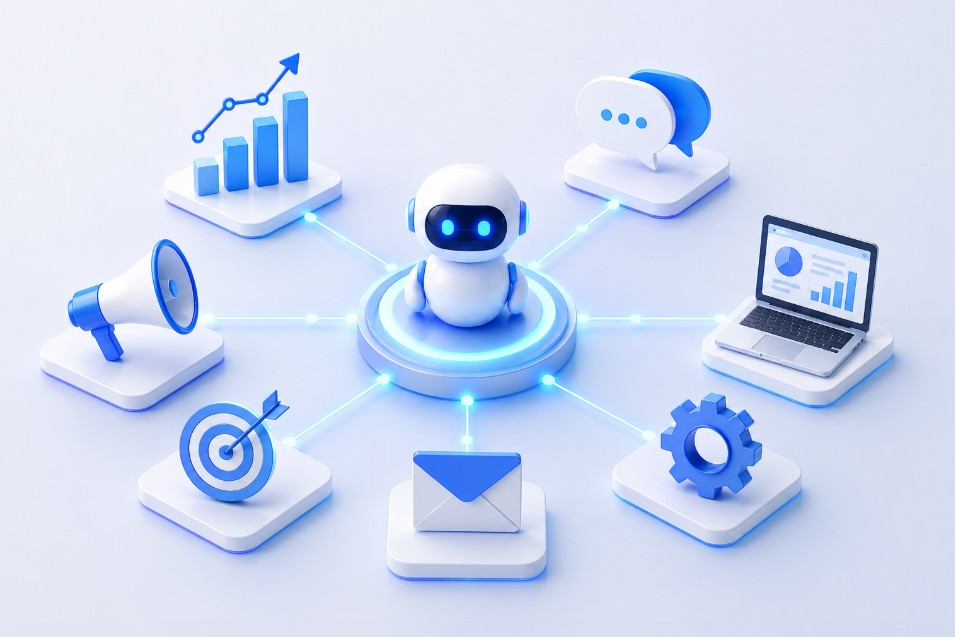
AT A GLANCE
Artificial intelligence has evolved beyond content generation and simple chatbots. Today's AI agents understand context, access business systems, and complete end-to-end workflows with minimal human intervention. By connecting marketing, sales, and customer service into one intelligent ecosystem, organizations can reduce repetitive work, improve collaboration, and continuously optimize business performance.
Artificial intelligence has evolved rapidly over the past few years. While many organizations first adopted AI for content generation, email drafting, and customer support, these tools still relied on people to make decisions and complete the remaining work.
Today, businesses are entering a new stage of AI adoption where AI agents do more than assist. They understand context, reason through problems, connect directly with CRM, ERP, advertising, and customer service platforms, and complete entire workflows with minimal human intervention.
Unlike traditional automation that follows predefined rules, AI agents continuously learn from customer interactions and business data to make better decisions over time. Their greatest value comes from connecting marketing, sales, and customer service into one intelligent workflow. By sharing information across the customer journey, AI agents eliminate operational silos, improve collaboration, and enable organizations to respond faster to changing customer needs.

AI Agents Across the Customer Journey

AI agents create the greatest business value when they work across the entire customer journey. By supporting marketing, sales, and customer service as one connected ecosystem, they automate repetitive tasks, improve decision-making, and enable teams to focus on strategic work. Through continuous learning, AI agents analyze real-time customer interactions and business performance, identify emerging trends, and recommend the next best actions.
Every AI agent follows the same intelligent workflow: Identify, Decide, and Execute. They first identify opportunities by analyzing customer and business data, decide on the best course of action using real-time insights, and execute tasks automatically across connected business platforms. While each type of AI agent serves a different business function, together they create a self-improving ecosystem that continuously enhances operational performance.
Marketing Agents
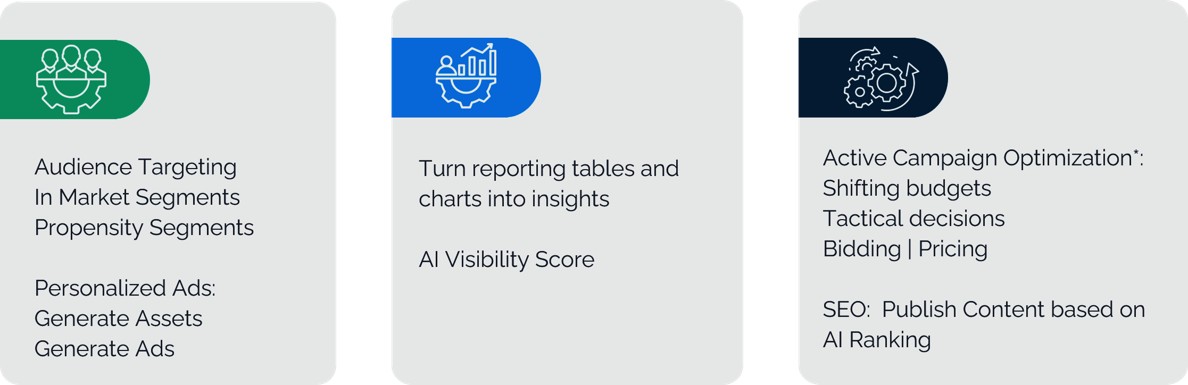
Marketing teams are expected to manage more channels, create more content, and optimize campaigns faster than ever before. AI marketing agents act as continuous optimization engines that monitor campaign performance in real time, allowing organizations to respond immediately to changing customer behavior instead of waiting for weekly or monthly reporting cycles.
Rather than relying on static automation, AI marketing agents continuously analyze campaign data across advertising platforms, CRM systems, and customer interactions. They identify performance trends, recommend budget adjustments, optimize audience targeting, refine messaging, and improve creative performance while campaigns remain live. As they learn from every campaign, they become increasingly effective at delivering the right message to the right audience at the right time.
Beyond optimization, AI marketing agents streamline content creation and campaign execution. They identify high-value audience segments, generate personalized creative assets and advertisements, transform reports into actionable insights, and continuously optimize live campaigns through intelligent recommendations. By automating these repetitive tasks, marketers can spend more time developing strategy while AI manages day-to-day execution.
Sales Agents
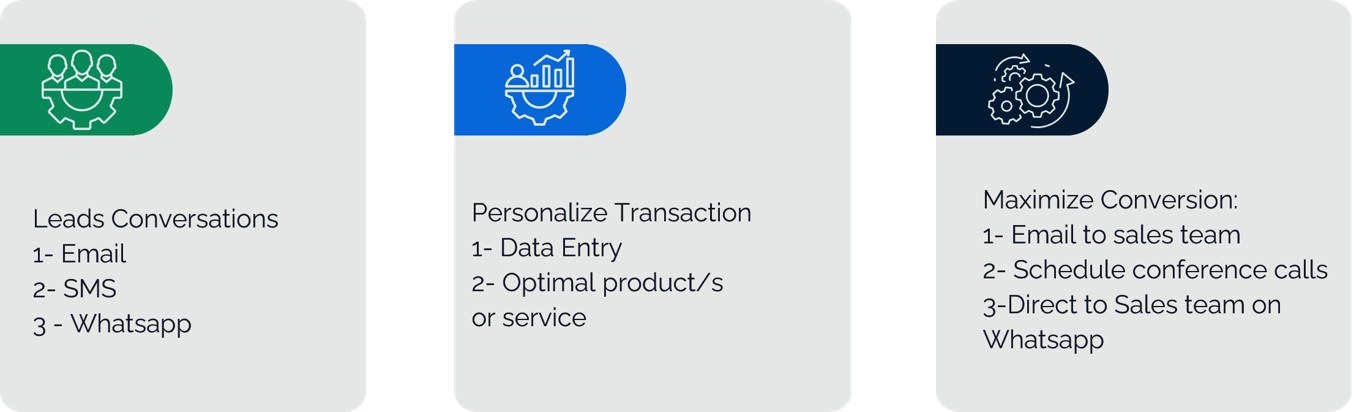
Sales teams often lose valuable time to administrative work, delayed follow-ups, and incomplete customer information. AI sales agents accelerate the sales pipeline by automating repetitive processes while ensuring every lead receives immediate and personalized engagement.
As soon as a new prospect enters the pipeline, AI agents initiate conversations through email, SMS, or messaging platforms, gather customer information, evaluate buying intent, and enrich CRM records automatically. They personalize product or service recommendations, maintain consistent follow-up sequences, and prepare qualified opportunities before transferring them to the sales team.
By supporting every stage of the sales journey, from initiating conversations to personalizing customer interactions and maximizing conversions—AI sales agents allow sales professionals to spend more time building relationships and closing business while AI handles repetitive execution behind the scenes.
Service Agents
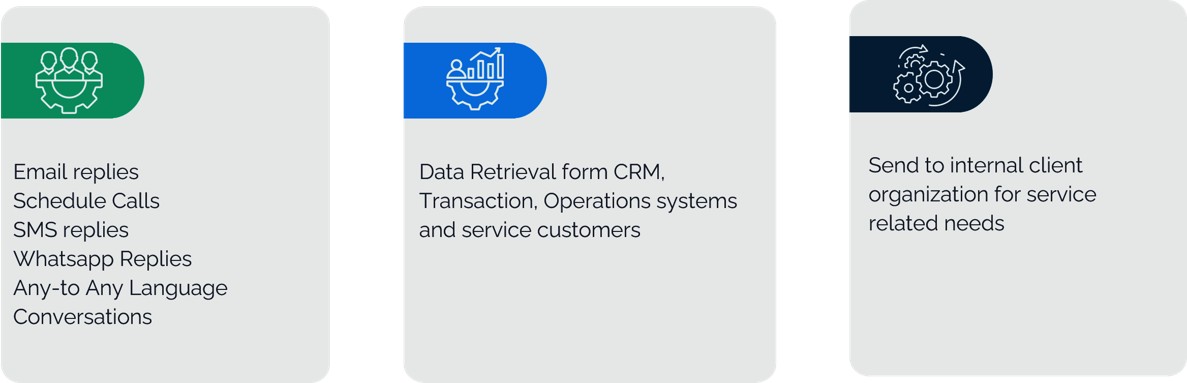
Customer expectations continue to rise as people expect fast, personalized support across every communication channel. AI service agents deliver consistent service experiences by combining conversational AI with direct access to CRM, operational, and transactional systems.
Instead of functioning as isolated chatbots, AI service agents maintain complete customer context throughout every interaction. They manage conversations across email, chat, SMS, WhatsApp, voice, and multilingual channels while retrieving customer records, order information, and operational data in real time. Routine requests can be resolved automatically, while more complex issues are seamlessly routed to the appropriate internal teams together with complete customer context.
By automating repetitive service tasks and coordinating information across departments, AI service agents shorten response times, improve service quality, and allow human teams to focus on high-value interactions that require empathy, expertise, and strategic problem-solving.
Agents Economics

The true value of AI agents lies in their compound effect. Unlike traditional software whose value often plateaus after implementation, AI agents continuously improve as they process more customer interactions and business data. Marketing insights strengthen sales conversations, sales interactions improve future marketing campaigns, and customer service data enhances every stage of the customer journey. As these connected agents continue learning, automation becomes smarter, recommendations become more accurate, and business performance continues to improve over time.
Beyond operational improvements, AI agents also deliver measurable economic value. By automating repetitive work across marketing, sales, and customer service, organizations can increase employee productivity while allowing teams to focus on strategic initiatives, creativity, relationship building, and complex decision-making. As AI agents assume routine tasks, businesses can reduce operational overhead, improve resource allocation, and create more efficient workflows across the organization.
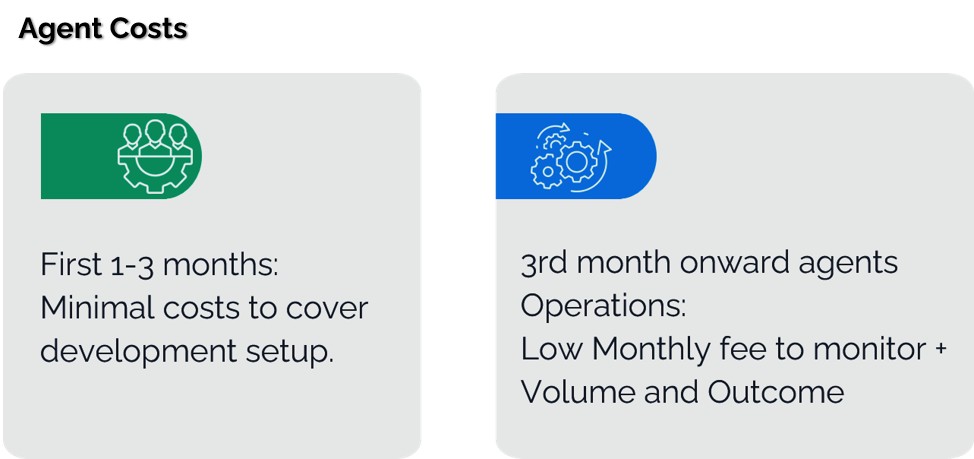
Implementing AI agents is also designed to be scalable. During the initial setup phase, organizations invest primarily in development, system integration, and workflow configuration. Once deployed, AI agents transition into ongoing operations with predictable monthly management and usage-based costs, allowing businesses to continuously optimize performance without significant additional investment. As AI agents learn and improve over time, organizations benefit from increasing returns through higher productivity, lower operating costs, and stronger long-term business performance.
Increase your marketing performace with Audience11 today: Audience11.com